
Interview with 3:AM Magazine
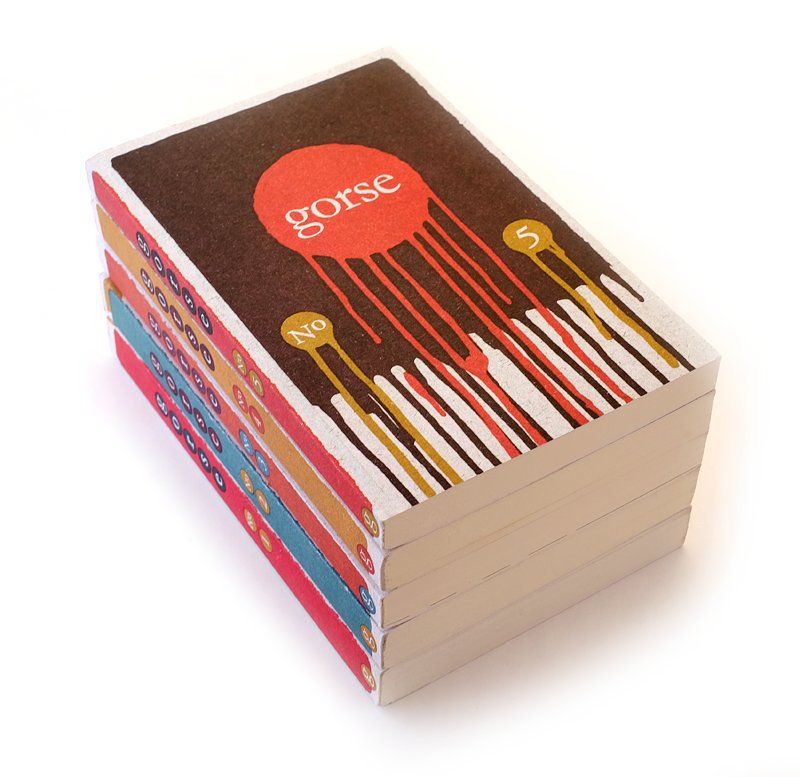
Image: Niall McCormack
We were interviewed by Tristan Foster for 3:AM Magazine. We talked of the objectives of gorse, the challenges in running a print journal with an interest in experimental writing, and future plans, including news of our publishing imprint which is launching next year.
3:AM: Why print?
ST: Print may seem a little archaic, but given the impermanence of the internet, it offers a sense of permanence. It’s also an opportunity to be super-analogue, to produce elegant publications, because of course print journals and periodicals aren’t supposed to be kept – much like those original Penguin paperbacks, they’re designed to be disposable – and our intention was to make something people might want to hold on to. It’s a tried and tested form of off-line curation if you like, a resistance against short attention spans, not so much a reframing rather a refocusing of how we read in the digital age. Much like Edmund de Waal’s installations, it’s to do with slowing down.
CM: It’s also an opportunity to examine what happens to reading – and in extension to writing – when it migrates back and forth between the online/digital and offline/analogue environments. It’s a form of translation that happens constantly and imperceptibly, and another form of border-crossing that we wish to probe and encourage. It’s also crucial to note we’re part of a narrow generation that grew up and was educated in analogue, pre-internet forms, but whose subsequent development happened in a digital and connectivity-enabled environment. This generation is afforded a brief vantage point informed by this two-dimensional experience, and there’s a responsibility that comes with that in terms of determining issues related to the control of information and communication – which in turn influence artistic approach, production, presentation and dissemination.
3:AM: gorse has fashioned itself as an Irish literary journal that takes a global view. Can you tell me a little about the rationale behind this approach – do you see gorse as extending the legacy of Irish writing?
ST: There is a wealth of journals in Ireland, an embarrassment of literary riches, really. There always has been. One of the main inspirations for gorse was a journal called The Bell, a journal that was conceived as a break from a stagnation caused by de Valera. Those early issues were a ground zero for new kind of ‘Irish’ writing – publishing Flann O’Brien, Brendan Behan, Patrick Kavanagh – and also a deliberate move away from the narrow view of Irishness. It was pretty global in its interest and content, and I’m consciously drawing from that legacy. I’ve talked about this before, how nebulous an idea I find the notion of ‘Irish Literature’. I’m not sure there is such a thing as national literature any longer, and I’m thinking here in particular of not only Camus who said he loved his country too much to be a nationalist, but also of Joyce and Beckett who transcended their Irishness, and more recently this new batch of ‘Irish’ writers who take more inspiration and nourishment from post-national, global sources. I know I certainly do: I read a lot of fiction in translation, and this has no doubt formed my approach to editorial direction. Having said all that, gorse is deeply rooted in Ireland. It’s as Hubert Butler said, local history is more important than a national one, and his essays on Russia, Spain and Yugoslavia and were really essays on Ireland.
CM: The current tendency towards nationalism throughout Europe and elsewhere is unmistakable, with its populist promotion a diversionary tactic and a distraction from real issues of power and control. Not everyone has the opportunity – or is forced – to live in a range of locations and cultures, but as John Holten remarked in a conversation with Karl Whitney on 3:AM in 2011, “translation is the lifeblood that sustains the conversations crucial not only to literary creation, but cultural understanding and development.” Reading literature through a national lens not only limits possibilities in engagement, interpretation and response, but encourages divisive and exclusionary thought.
The interview can be read in full here.