stomaselli

Tatlin doesn’t live here anymore
TatlinatHome

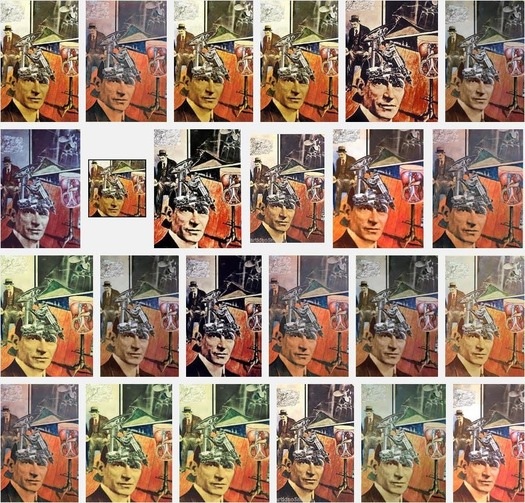
Rick Poynor on Raoul Hausmann, collage (‘the most important innovation in the art of the twentieth century’) and Pinterest.

But Tatlin at Home is a historical artifact, not a throwaway image, so which pin was the most accurate as a representation? There were large differences in color and small but nagging variations at the edges of the image. The right-hand edge seemed particularly unlikely in all the pins I looked at. Having cut out the dressmakers’ dummy containing body organs and the fire extinguisher underneath, why would Hausmann then choose to slice and crop them so awkwardly? On the other side of the collage, the man’s hand and foot comes and goes and the crop on the ship’s propeller at the top also varies. Not for the first time it seemed I would have to leave Pinterest to find the most reliable online source and with art, as a rule, this tends to be the museum that owns the piece. Before doing that, I consulted some books, seven in all, that reproduce Tatlin at Home. From William S. Rubin’s Dada & Surrealist Art (1968) to Dawn Ades’ Photomontage (revised ed. 1986), it became clear that in the original the complete edge of the dressmakers’ dummy could be seen, as well as most of the fire extinguisher (though both of these older reproductions are in black and white).
Non-creative writing

GeoffDyer

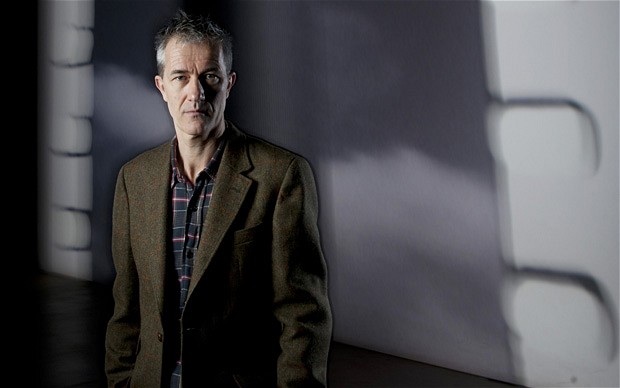
Geoff Dyer’s Art of Nonfiction Paris Review interview.

My motto is always, “If you’re not overprepared you’re underprepared.” I’m a grammar-school boy, I do my homework. Likewise, in the fiction, so much of the stuff is drawn from real life. But that’s not the point really. The point is that the techniques are pretty much the same in fiction and nonfiction. It’s not like Susan Sontag, where there’s an easily recognizable division between the two. Sontag was always saying, Why don’t you adequately acknowledge the greatness of my fiction? Well, there are several possible responses to that, but the important thing is that she accepted a separation that I reject. It’s just a bunch of books. To go back to your earlier question, I think the distinction between fiction and nonfiction is less about “Did it really happen or was it made up?” than it is about form. And, more than form, it’s about the expectations that are brought to certain forms. According to how a book is presented, packaged, or identified, readers have certain expectations. Following from that they expect books within broadly identified categories to behave in certain ways. So people can find it quite disconcerting when a book isn’t doing what they think it’s meant to be doing, even if the book is completely fine on its own terms and has no desire to conform to some external set of expectations. My books are often disappointing in that regard. Maybe in other ways, too, but I am mercifully and necessarily oblivious on that score.

The flâneur on film

BeforeSunrise

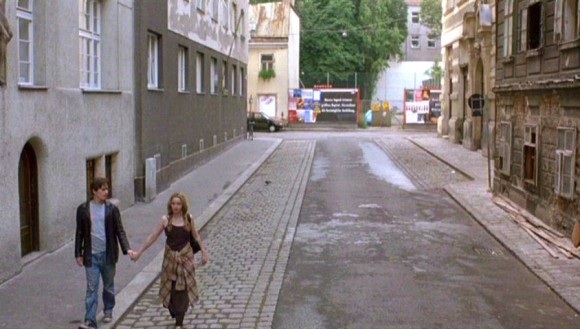
Rob Stone on Richard Linklater and the dérive in cinema.

The flâneur’s accumulation of experiences and influences often results in an indistinct outcast figure, one who walks to a different rhythm, defined and maintained by an absence of clear origins and a lack of explicit direction. Consequently, the flâneur can be disruptive where a sense of rootlessness and rejection of settlement renders the figure as threatening Other.

All the way to Reno

RachelKushner

Brilliant interview with Rachel Kushner in Guernica. Discussed: register, range, realism, Roberto Bolaño, violent histories, Proust, Robert Altman, sentences.

There is no single formula. An invisible integument that gives the sentence wholeness and musicality, sometimes. But other times, the formula is almost purely one of context. And yet other times, of sheer precision of meaning.

Introducing: Kevin Breathnach

KevinBreathnach

Kevin Breathnach is the literary editor of Totally Dublin. His criticism also features in The Irish Times, The Stinging Fly, The Quarterly Conversation and 3:AM Magazine. He is also a fine essayist; we’d especially recommend This is Not the Deal (on the fine print), Stalker/Zona, and Pont Blank (on modernist photographic tradition), all in The New Inquiry. For gorse, Kevin turns his gaze to the artist portraits of Henri Cartier-Bresson.