
Blog

Echoes of Mondrian

LynchPylon

Sean O’Hagan reviews The Americans are Coming, Warhol, Burroughs and Lynch at the Photographers’ Gallery.

In this triumvirate of maverick American talents, David Lynch emerges as the most old-fashioned, that is to say, formally consistent photographer. In The Factory Photographs he is represented by his pictures of the single subject of the title – deserted industrial spaces. (He also photographs nudes and forlorn snowmen.) His black-and-white photographs of decaying buildings are really black and grey. Taken as a whole they make a kind of elegy to industrialism and, in their ominous darkness, possess a unified aesthetic that sets him apart from the other two artists.
Introducing: Darran Anderson

darrananderson

Editors’ note: As we head towards publication, we thought we would introduce our contributors.

Fantômas, Lolita, cargo cults, poèts maudits, who better to tell a Serge Gainsbourg story than Darran Anderson? Whether it’s essays on memento mori, imaginary cities, the night, the Shipping Forecast or the literary nasty, if Darran keeps writing ’em, we’ll continue to read. He is, as Lee Rourke says, one of our brightest minds. His essay for gorse is on the moderns and their literary and artistic antedcedents.

Je est un autre

Babel

The January issue of The White Review is a translation issue, edited by Daniel Medin, and features

Dada serious

HannahHoch

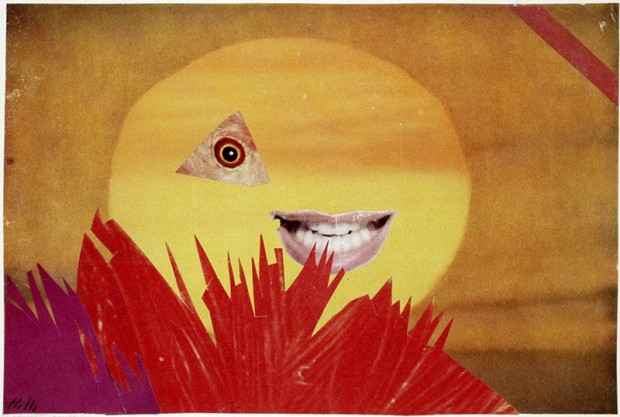
Brian Dillon on Hannah Höch, ‘art’s original punk.’

Cut With the Kitchen Knife is Höch’s best-known work, though it’s something of an anomaly – not least in its scale – and it does not appear in the Whitechapel Gallery‘s new exhibition. Höch claimed she had hit on the technique of photomontage while on a Baltic holiday with the married Hausmann in 1918; having come across mocked-up photos sent home by German soldiers, in which the young men’s heads were superimposed on pictures of musketeers, they realised the power of cut-and-paste to “alienate” images. This origin tale is slightly misleading, however, because since 1916 Höch had been working for the Berlin publisher Ullstein, producing embroidery and lace designs for such periodicals as Die Dame and Die Praktische Berlinerin. She was probably already familiar with the kinds of collage that an expanding print media practised with photographs. Höch worked on these handicraft magazines for a decade, and even wrote a manifesto of sorts for modern embroidery, in which she enjoined Weimar-era women to “develop a feeling for abstract forms”.

Introducing: David Winters

DavidWinters

Editors’ note: As we head towards publication, we thought we would introduce our contributors.

David Winters is an invigorating literary critic (“criticism will be renewed by being disembedded, deligitimized, deinstitutionalized”), who has lead discussions on Gordon Lish (“it’s no overstatement to say that Lish is to the second half of the 20th century what Gertrude Stein was to the first”) and modernism. In an interview with HTMLGiant David said,

“Perhaps every novel contains a “theory” of the novel, as part of its cache of tacit knowledge. A novel has an understanding of itself, whether it knows it or not…“The novel” as a grand project: the idea fills me with nervous exhaustion. What I can say with confidence is that I’m less and less interested in that sort of novel. I’d rather read a book that wants to do away with itself. Deep down I closely identify with literature, but I also compulsively want to kill literature.”

For gorse, David interviews literary experimenter Evan Lavender-Smith.