Blog

Sturdy piston

BrianDillonPen

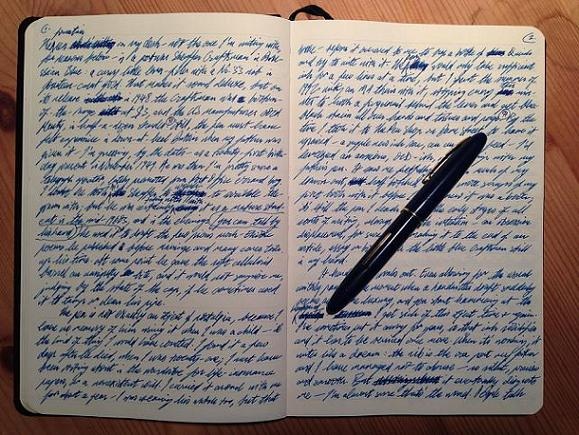
Nice little essay by writer and art critic Brian Dillon on fountain pens.

The pen is not exactly an object of nostalgia, because I have no memory of my father writing with it when I was a child. I found it after he died, when I was twenty-one; I must have been rooting in the wardrobe for life-insurance papers or a nonexistent will. I carried it around with me for about a year — I was wearing his watch too, but it slipped from my wrist on the library stairs — before it occurred to me to buy a bottle of Quink and actually use it. The pen would only suck up sufficient ink for a few lines at a time, but I spent the summer of 1992 writing an MA thesis with it, stopping every ten minutes to hook a fingernail behind the thin gold lever and get blue-black stains on my fingers.

By the time I took it to The Pen Corner on Dame Street to have it repaired — a supple new ink sac, an unclogged feed — I’d developed an anxious, OCD-ish, relationship with my father’s pen. It saw me fretfully through much of my drawn-out, half botched Ph.D. I wrote scraps of my first book with it, before I knew it was a book. It’s still the pen I reach for in the early stages of all sorts of writing, always with the intention — an obsessive displacement, for sure — of making it to the end of an article, essay or book with the little Craftsman still in my hand.

[Via @HamishH1931]
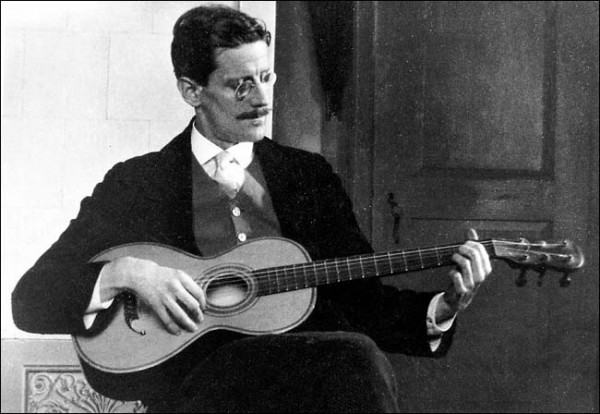
Drowned in sound

JamesJoyceGuitar

In ‘Re-Joyce’, Darran Anderson talks about how books change as the reader does, how some are best read with wisdom, others in the “full incandescent stupidity of youth”. “The best,” he says, “somehow change continually.” He mentions James Joyce‘s Dubliners, specifically ‘The Dead’, and how much it had changed from how he remembered it, in particular, that last paragraph.

A few light taps upon the pane made him turn to the window. It had begun to snow again. He watched sleepily the flakes, silver and dark, falling obliquely against the lamplight. The time had come for him to set out on his journey westward. Yes, the newspapers were right: snow was general all over Ireland. It was falling on every part of the dark central plain, on the treeless hills, falling softly upon the Bog of Allen and, farther westward, softly falling into the dark mutinous Shannon waves. It was falling, too, upon every part of the lonely churchyard on the hill where Michael Furey lay buried. It lay thickly drifted on the crooked crosses and headstones, on the spears of the little gate, on the barren thorns. His soul swooned slowly as he heard the snow falling faintly through the universe and faintly falling, like the descent of their last end, upon all the living and the dead.

Into the dust of his own mind

EMCioran

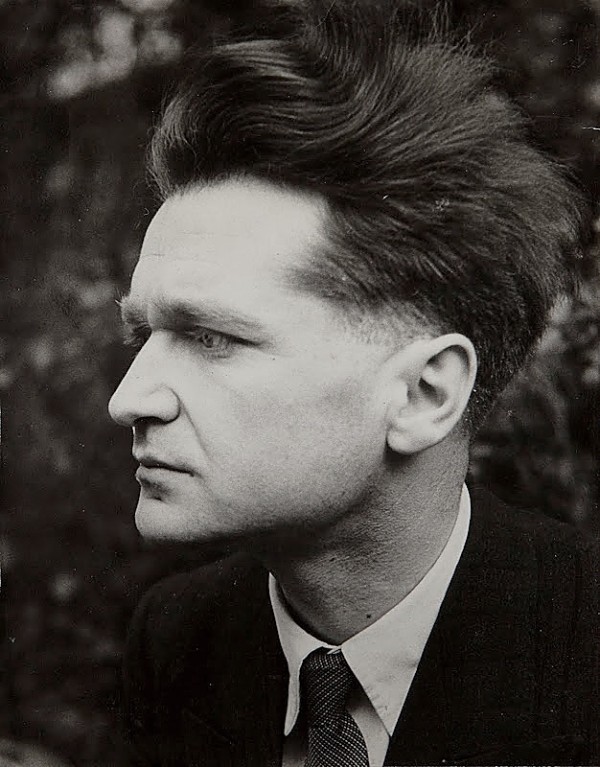
‘Toward a Vegetal Wisdom,’ Paul Stubbs’ essay on the writings of E.M. Cioran.

If he was not necessarily a writer of vision, certainly not of the imagination, he was nonetheless a writer of the eternal detour, possessed only of the haunted desire to waste the ghost of himself upon the template of an artificial existence. Unnaturally human, he swayed in tandem to the nerve-blades of his own despair, lost as he was to reality as if to the contingency of an always shadowy impasse. He had a Nietzschean temperament in the sense of being only a pebble of Nietzsche’s mountain. He never quite amounted to anything more than what happened to him. And despite possessing the necessary rancour and hostility to end entire cultures and civilizations, he never did. Merely he fainted into each faithless epoch of history, and on waking knew that he would always be unable to ever conform in the flesh to his own image of himself.

[Via Black Herald Press]

Watt is the what

SamuelBeckett

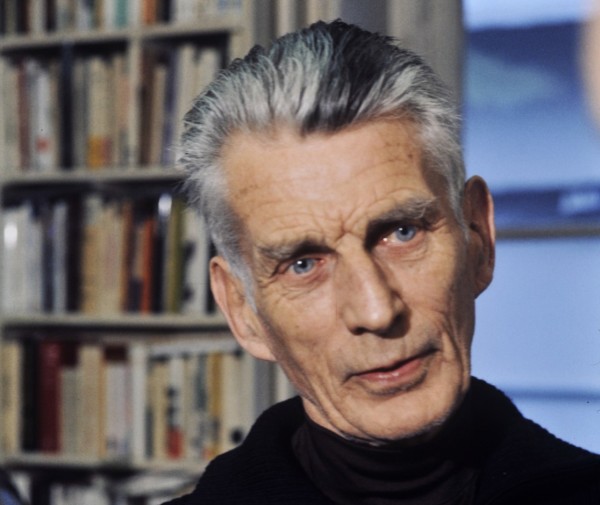
Paul Auster on Watt, and laughter in Beckett‘s writing.

Turd and fart…” You are breathing again, and an instant later you find yourself laughing. Schoolboy humor surging up through the fake-scholarly discourse of the opening sentences, an utter surprise in the context of what came earlier, and then, before you can fully adjust, you understand that Beckett is talking about Ireland and the music of the English language when it comes out of the mouth of a working-class Irishman. “Turd and fart, he said, for third and fourth.” And indeed, it is a fair rendering of that music, you say to yourself, even as you go on laughing at Beckett’s prank.

(Via @seanjcostello.) See also, Auster’s Beckett lecture .

Language tricks

image

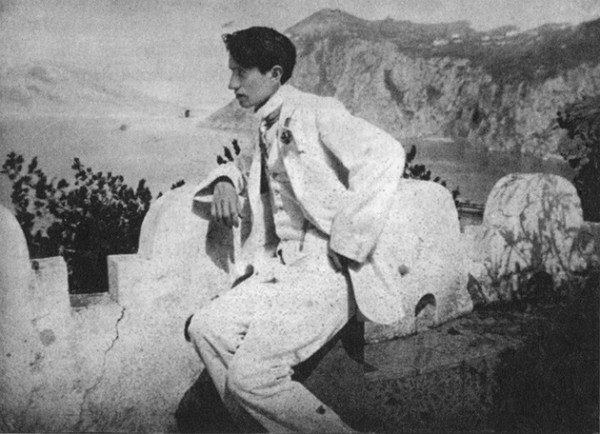
Adam Thirlwell on Sigizmund Krzhizhanovsky.

Krzhizhanovsky’s fiction is based on the fact that language makes things possible that are not possible in reality. If there is a word for “role” and a word for “character,” then naturally, it follows, according to this method, that the two could possess separate existences. Or, to put this maybe more precisely, he investigated whether the distinction between what is possible in language and reality is even tenable at all. And so the central mechanism of this writing is metaphor (“a three-by-four-inch slip of paper torn out of the notebook had miraculously turned into lodgings measuring one hundred square feet”) — the hinge between animate and inanimate objects, which allows figures of speech to acquire a strange kind of life.

While this attention to the act of writing could, I suppose, be defined as metafiction, Krzhizhanovsky’s real subject is not the gap between fiction and reality so much as the gaps inside the real itself. The metafiction is really metaphysical. So that it should be no surprise if a corpse, in “Autobiography of a Corpse,” reasons in this manner, arguing that space “is absurdly vast and has expanded — with its orbits, stars and yawning parabolas — to infinity. But if one tucks it inside numbers and meanings, it will easily fit on two or three bookshelves.” It is just one more example of Krzhizhanovsky’s exploration of language’s tricks.