stomaselli

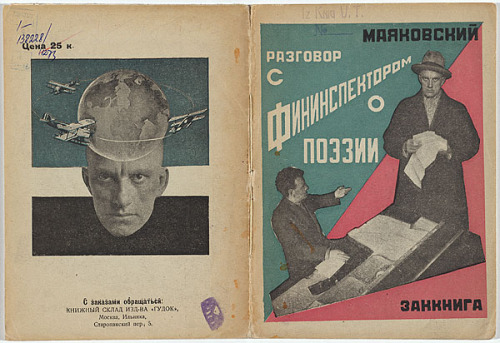
The line is a fuse*

Mayakovsky

gorse is intended as a print object (we have strong views on this: see a 2016 interview with our editors at 3:AM Magazine, specifically, why print?). However, as we wait for our printers to re-open (to publish issue 11 of the journal), we thought we’d share the Editorials from past issues (now, mostly, out-of-print).

Vol. I (gorse nos 1-4)
1/ Where the Dead Voices Gather, gorse no. 1, January 2014
2/ We Go This Way, gorse no. 2, September 2014
3/ Whale in the Moon When It’s Clear, gorse no. 3, March 2015
4/ Wonder is Really Nothing, gorse no. 4, September 2015

Vol. II (gorse nos 5-10)
5/ The Geometry Blinked Ruin Unimaginable, gorse no. 5, March 2016
6/ Je est un autre, gorse no. 6, August 2016
7/ Falsing (After Marconi), gorse no. 7, December 2016
8/ Ex Corpore: A Study for Five Figures, gorse no. 8, March 2017 [Note: gorse no. 8 was printed without an editorial to allow the body of work to speak for itself. The editorial was accessible only on the website. For that reason, no PDF exists]
9/ A Kind if Blue, gorse no. 9, October 2017
10/ Editorial, or, why a bag of rubbish is not just a load of garbage** [PDF], gorse no. 10, September 2018

*From Mayakovsky’s Conversation with a Tax Collector about Poetry
** Christodoulos Makris’ Editorial for g10 is presented as it was designed, as a fold-out information sheet similar to those found in medicine boxes
Wonder is Really Nothing

alice4big

‘As we lie down to sleep the world turns half away
Through ninety dark degrees.’
– Elizabeth Bishop

GK Chesterton said that nonsense was the literature of the future. There is no better proponent than Charles Lutwidge Dodgson writing as Lewis Carroll, no greater triumphs of nonsense than the Alices. Carroll insisted his books ‘meant nothing,’ made no sense.

Still, you know, words mean more than we mean to express when we use them; so a whole book ought to mean a great deal more than the writer means. So whatever good meanings are in the book, I’m glad to accept as the meaning of the book.1

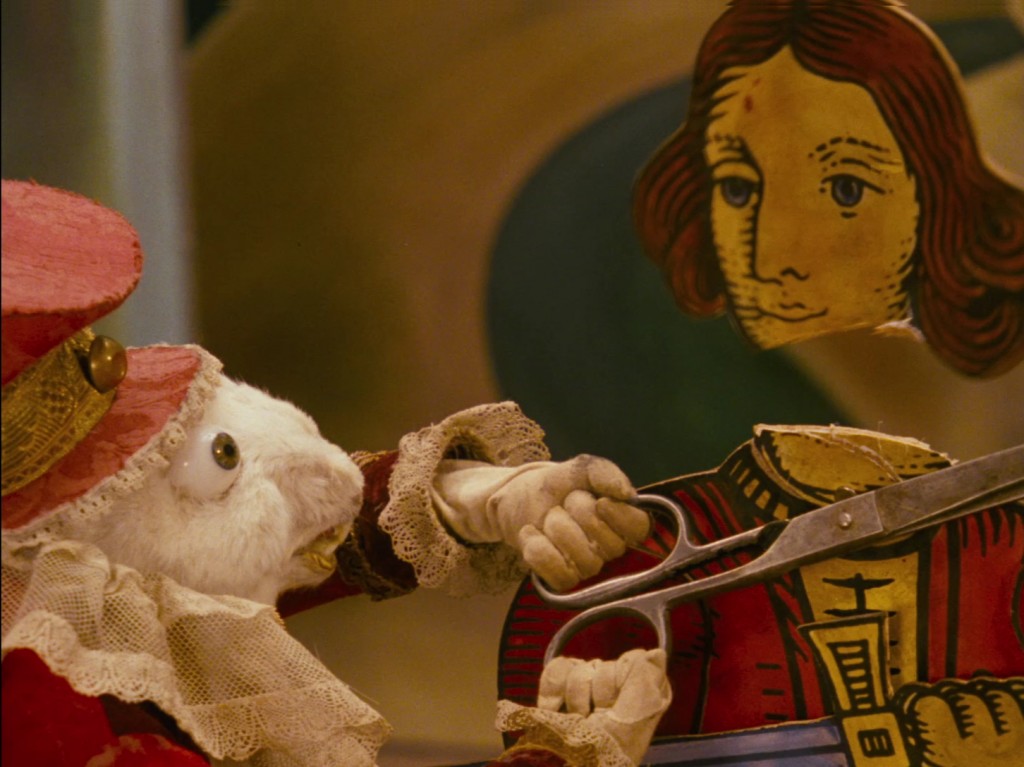
Alice, according to Carroll, was intended to be ‘trustful, ready to accept the wildest impossibilities with all that utter trust that only dreamers know.’ Carroll’s dream story is one with loops, entanglements, and passages that lead to nothing. It was essentially a new way of writing dreams: while Jonathan Swift took pains to explain everything, and Shakespeare carefully laid the groundwork for what was to come in his midsummer capers, Carroll offered no explanations whatsoever. Alice follows a rabbit straight down a hole and is in Wonderland, a space where you open doors with keys only to find more doors, games are played with animate objects, and events repeat ad infinitum.

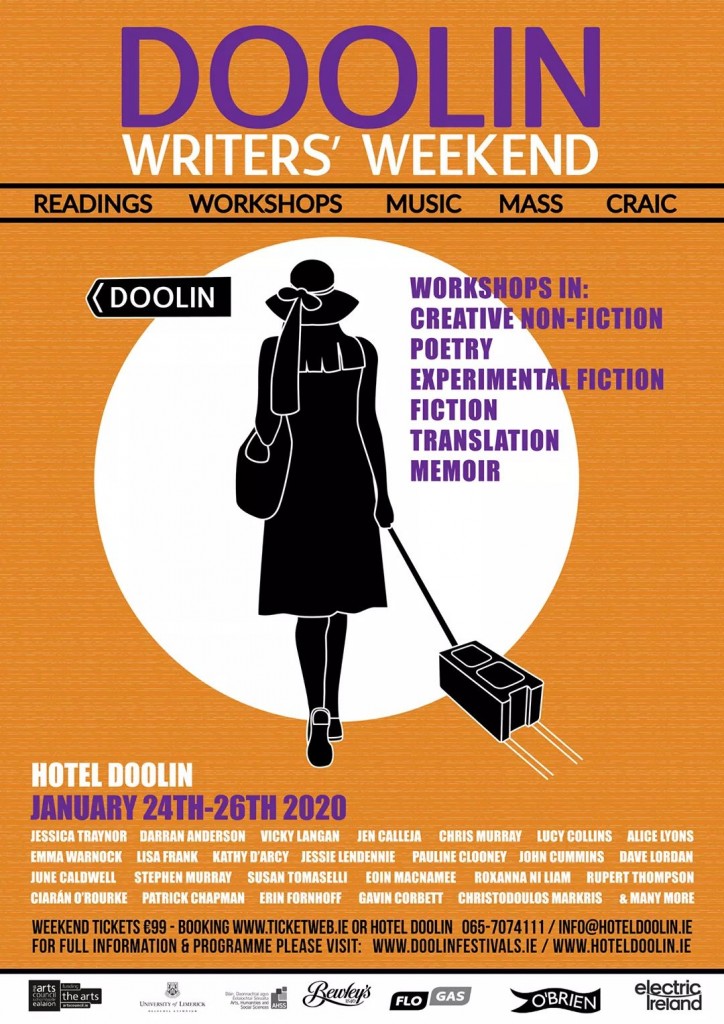
Doolin Writers’ Weekend 2020: A Report

FB_IMG_1575395266419

I was privileged to be the guest curator at the 9th annual Doolin Writers’ Weekend, which took place at Hotel Doolin, Co. Clare, 24-26th January 2020. Tired of the emphasis in festivals (usually) being on newness, or being led by publishing schedules, I decided, with full support from hotel manager and Writers’ Weekend organiser Dónal Minihan, to shift the focus to more experimental practices, to programme emerging artists and more marginalised writers. I called my introductory speech ‘Two Forks in the Path,’ and it went something like this:

gorse 13 submission call

entartete-kunst.-fÜhrer-5314322


“We learn from history as much as a rabbit learns from an experiment that’s performed upon it.”

– W.G. Sebald


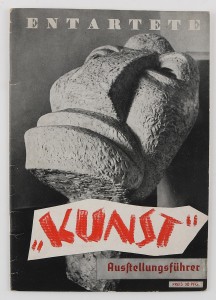
In July 1937, the Nazi party put an art exhibition in Munich: Entartete Kunst, or, Degenerate Art. 740 modern works that the Nazis did not approve of were shown to ‘educate’ the public on the ‘art of decay.’ It was a rail against modernity and the moral collapse associated with it. The exhibition handbook explained that the aim of the show was to ‘reveal the philosophical, political, racial and moral goals and intentions behind this movement, and the driving forces of corruption which follow them.’

We are living in dark times. We want artistic responses to the theme of ‘Taboo.’  We are looking for fiction, essays, poetry, and art. Help us shine a light: info [at] gorse [dot] ie, subject line ‘gorse 13 taboo’. Submissions are open from 13th December until 10th January.