stomaselli

‘All future plunges to the past’
gorsecrop

If you missed it over the holidays, we revealed our cover, designed by the very talented Niall McCormack. The idea behind it is that of a typewriter, but given our outlook, it also represents pins on a map. We love it, and hope you do too.

As both Darran Anderson and Karl Whitney have written a little about their essays for the issue, we thought that this week (and next) we’d write a little about each contributor, and perhaps share a taster from their piece for gorse.

We’ve (just) passed the print deadline for becoming a ‘friend of gorse‘ – and thank you for the generosity you’ve shown so far. We’re still accepting donations, though you’d now be thanked the second print issue as opposed to the first. And of course, issue one is still available for pre-order here.
Dos Passos’ America

JohnDosPassos

Will Augerot on the magnificent U.S.A. trilogy.

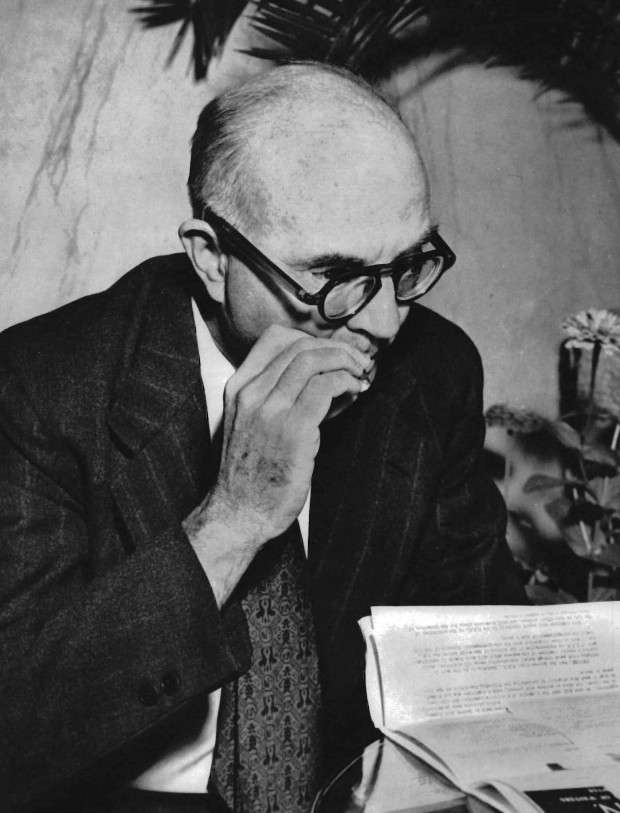
I’m not sure that any writer today is writing fiction as contemporary in substance as that which John Dos Passos was writing in the 1920’s and 30’s. Precarious, exploited youth; economic catastrophes; senseless warmongering; cynical self-promoters; feckless media beholden to entrepreneurial myths: the U.S.A. trilogy has it all. Dos Passos died in 1970, but behind his prose a reader can sense the presence of an intelligence that somehow, anachronistically, understands our maddening yet hopeful times. Unfortunately, U.S.A. has suffered its share of high-profile detractors, and the reputation of the novelist that Jean-Paul Sartre called “the greatest writer of our time” isn’t what it once was.

The Short Fiction of Flann O’Brien

flannobrien

By Adam Rivett.

Flann O’Brien didn’t have much respect for the traditional novel as we’ve come to know and scarcely tolerate it. At-Swim-Two-Birds, his first, can barely get started before it’s wandering down the winding track of digression and self-conscious hyperbole, all tongue-in-cheek mythology and undergraduate linguistic bluster. His second (and arguably greatest) novel, The Third Policeman, trades in the virtuoso style of the debut for a plainer prose, but, indisputably, a bleaker world view. Play becomes despair, and youthful drunken rhetorical games grow surreal and morbid. There was, from the outset of O’Brien’s work, a fundamental impatience with received forms. The ‘ideal’ novel that is so often rewarded these days – realist, tightly plotted, tastefully ‘well written,’ and above all consistent – is not O’Brien’s. Yet Birds is one of the 20th Century’s great debuts. Its voice – sardonic, harshly original, comfortable in numerous registers – seems formed and confident from the start. Reading the small amount of pre-Birds material in the new collection The Short Fiction of Flann O’Brien, then, gives us, among other things, the only clue we have as to how the man otherwise known as Brian O’Nolan got it so right so fast.

The reality of the street

LeFlaneur

The revolutionary act of urban walking.

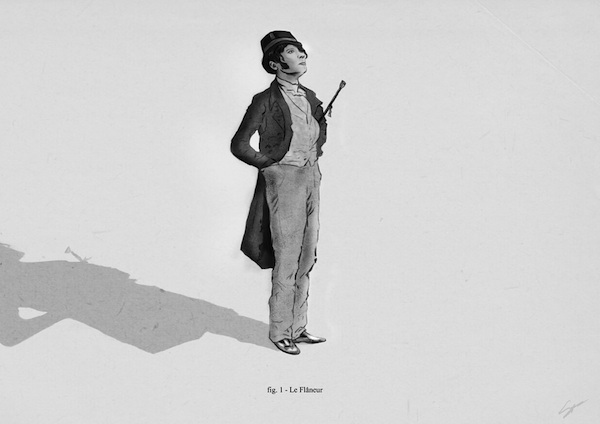
There was a whole band of urban ramblers exploring the insalubrious and unheralded districts of London during the interwar years. In books such as Gordon S Maxwell’s The Fringe of London, Thomas Burke’s The Outer Circle and James Bone’s The London Perambulator, the previously overlooked suburban hinterland of the city was treated with the same reverence as more conventional heritage sites. The workaday city was celebrated as a land rich in legend and wonder. In the same period, George Orwell was undertaking his politicised tramps around London and into the Kent countryside to experience the hardships endured by the homeless and destitute; then he walked his way from Coventry to Wigan Pier, chronicling the “distressed areas” of the north.

Yet it was a bunch of Parisian gadabouts who turned this damp-tweed form of subversive schlepping into a codified art. For members of the Situationist International (SI), such drifts were fact-finding missions for the transformation of urban living and society in general. The walks were recast as dérives and the findings formed the new pseudo-social science of psychogeography. The intent was overtly revolutionary. Radicalism was not cloaked in the guise of a walking guide; the SI’s ambulatory studies of the Paris suburbs were “reconnaissance missions” for the revolution that was to come – and it very nearly did in May 1968.

[Image]

Encounter at the crossroads of Europe

StefanZweig

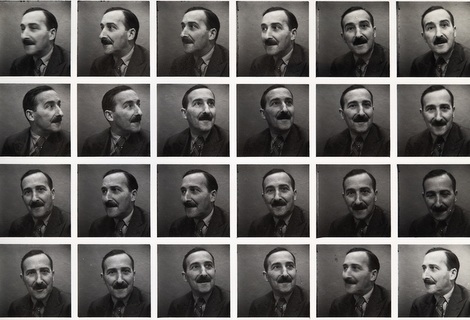
Will Stone, translator of Stefan Zweig‘s Nietzsche [a gorse read of 2013], on Zweig and Emile Verhaeren.

In Berlin, apart from his studies and bohemian indulgences, Zweig sought a more expansive freedom in literary terms, and caught the bug of translation. He began to explore further afield, even translating poets such as Keats and Yeats and producing with other translators a collection of Verlaine’s poetry to which he added a critically acclaimed introduction. But all the time he was moving closer to Belgium, drawn by the rich crop of its home grown artists and writers who seemed to integrate their works in fresh and creatively productive ways. So in the summer break of 1902, long anticipating a visit to the ‘little land between the languages’, Zweig made his move.

[..]

The vital importance of Zweig’s meeting with Verhaeren in relation to his ensuing career as a writer, emissary of humanism and key proponent for the higher ideal of a Europe of cultural unity, cannot be underestimated. The contrast between Verhaeren’s openness, curiosity, vitality, not to mention the explicit visionary credentials he held, and the self conscious dandified Viennese poetry circles Zweig had moved within was extreme. It was if Zweig himself had suddenly been released from a reserve of pampered elites into the rawness and unpredictability of the wild and could finally breathe real air, taste real food and appreciate the creative potential of risk and unpredictability. In Verhaeren’s verses he saw bold new vistas opening up which seemed to strike a necessary chord with the rapidly transforming epoch, as the fabled ‘golden age of security’, guarded by the Hapsburg realm unceremoniously gave way to something far more restless, ominous and uncertain.